Radiant Heat vs Forced Air
Why is radiant heat a better way to heat a home compared to forced air heat?
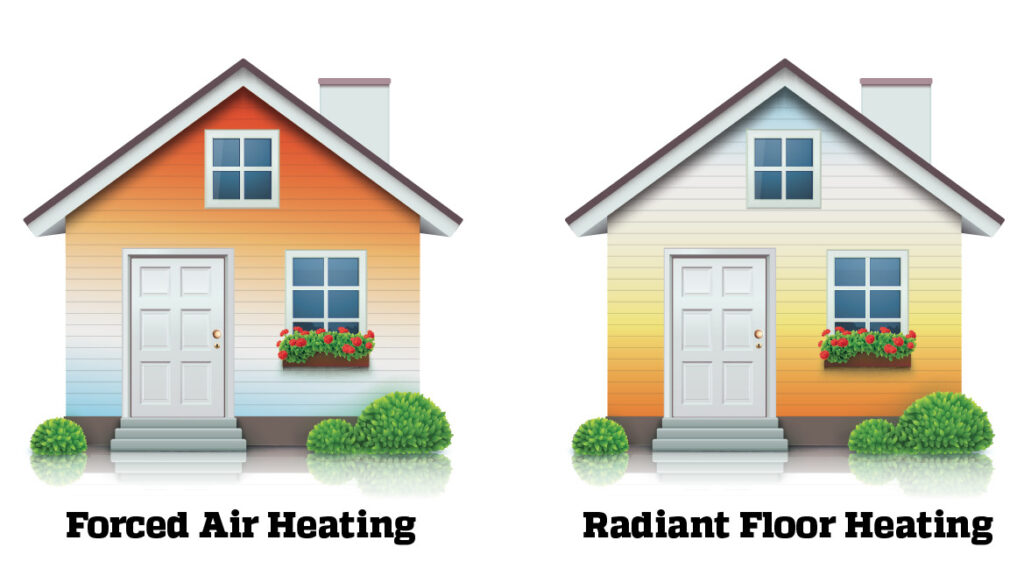
Compared to forced hot air, radiant floor heating is more comfortable, more energy efficient, provides a healthier environment and is more aesthetically pleasing. Here’s why:
Radiant means Comfort
Comfort is hard to define. It’s best understood as the absence of discomfort. In that light, perhaps the most remarkable thing about radiant heat is what you won't notice. There are no forced air registers to see. No noise or dust from mechanical blowers. No hot air blowing on you to exacerbate winter dryness. No hot air rising to overheat the ceiling, wasting energy. No cold floors to chill your feet in the morning. The mild warmth of a radiant floor is a subtle experience and always feels just right.
Radiant Heat Saves Energy
A typical radiant heated home in the United States can expect a 25% energy savings over a conventional forced air home. This 25% savings can be attributed to a number of factors listed below (The 25% figure comes from a 1998 study by Kansas State University and the American Society of Heating Refrigeration and Air-Conditioning Engineers [ASHRAE])
- Parasitic losses
Parasitic loss refers to energy lost due to inherent inefficiencies of a system. Duct work in a forced air heating system, for example, can be difficult to permanently seal/insulate and is often located in unheated crawl spaces or basements. As hot air is blown through these large ducts, heat is lost through the tiny flaws in the system and escapes into unknown areas.
Additionally, when hot air is blown into a room with a door closed, it can cause an increase in air pressure. This pressure pushes the heat through weather stripping on windows. Blowers used in forced air systems on average require 9x the amount of electricity as the pumps in radiant systems. All of these parasitic losses add up in forced air systems add up to a 30% less efficient system. - Lower ceiling temperatures
Forced air systems emit hot air at a temperature of approximately 120–140 degrees Fahrenheit. This hot air rapidly rises, creating a temperature zone that can often be over 10 degrees warmer than the air below. This stratification effect becomes greater as the ceiling height increases. When ceilings are hot and just below a cold roof, heat loss is quite high. It is precisely because of this effect that we insulate ceilings and attics so much. - Zoning reduces energy usage
Most forced air homes have a single thermostat. In other words, they are single zone systems. This is because forced air systems are inherently difficult and therefore, expensive to zone. The result is a top story that's too hot, while downstairs remains cool. Or rooms facing direct sunlight become overheated while other rooms are inadequately controlled. - Lower air temperatures for the same comfort
When we are outside on a warm, sunny day, we may be comfortable in a tee shirt even if the air is only 60 degrees. This is because the radiant warmth from the sun allows us to be comfortable at a lower air temperature. The same is true in your home. With the warmth emanating from a radiant floor, we can the same level of comfort with the thermostat is set a few degrees lower than needed in forced air home. - Blowing hot air paradoxically can cool us
We can be quite comfortable outside until the wind picks up. Even though the temperature has not changed, the movement of air across our skins causes evaporative cooling. Paradoxically, hot air blowing from a duct may require you to set the thermostat slightly higher to maintain the same comfort.
Radiant Heat is Healthy Heat
Forced air systems not only blow hot air, they also push allergens, dust and other airborne particles to every room in your home. Improved indoor air quality can reduce allergies, medical bills, incidences of asthma and more. European studies indicate that dust mite populations are reduced as much as 90% in radiant heated homes. And a quiet, peaceful environment, devoid of noisy fans and blowers), is a healthier and more relaxing environment too.
Radiant Heat Allows Design Freedom
Architects gain total design freedom because there are no floor registers, no baseboard radiators, and no wall or ceiling chases. Furniture can be placed anywhere without regard to registers. And rooms with high, open ceilings and/or floor-to-ceiling windows can be heated easily and efficiently. Mechanical systems for radiant systems can also be designed more freely because of the ability to easily interface with solar, geothermal and cogeneration fuel cells.
How Does Radiant Cooling Work?
Since cold air falls and hot air rises, it’s better to heat through the floor and cool through the ceiling. This can be accomplished in several ways. Where framing allows, conventional ductwork and an air handler are used. Where framing limits the use of conventional ducting, there are high-velocity small diameter duct systems or mini-split systems that have no ductwork.